


DTF printing FAQ
Answers to common questions about DTF printing by the metre, artwork preparation, lead times, delivery and payment.
Key answers in one place
If you cannot find what you need below, get in touch. Larger or unusual projects are handled individually.
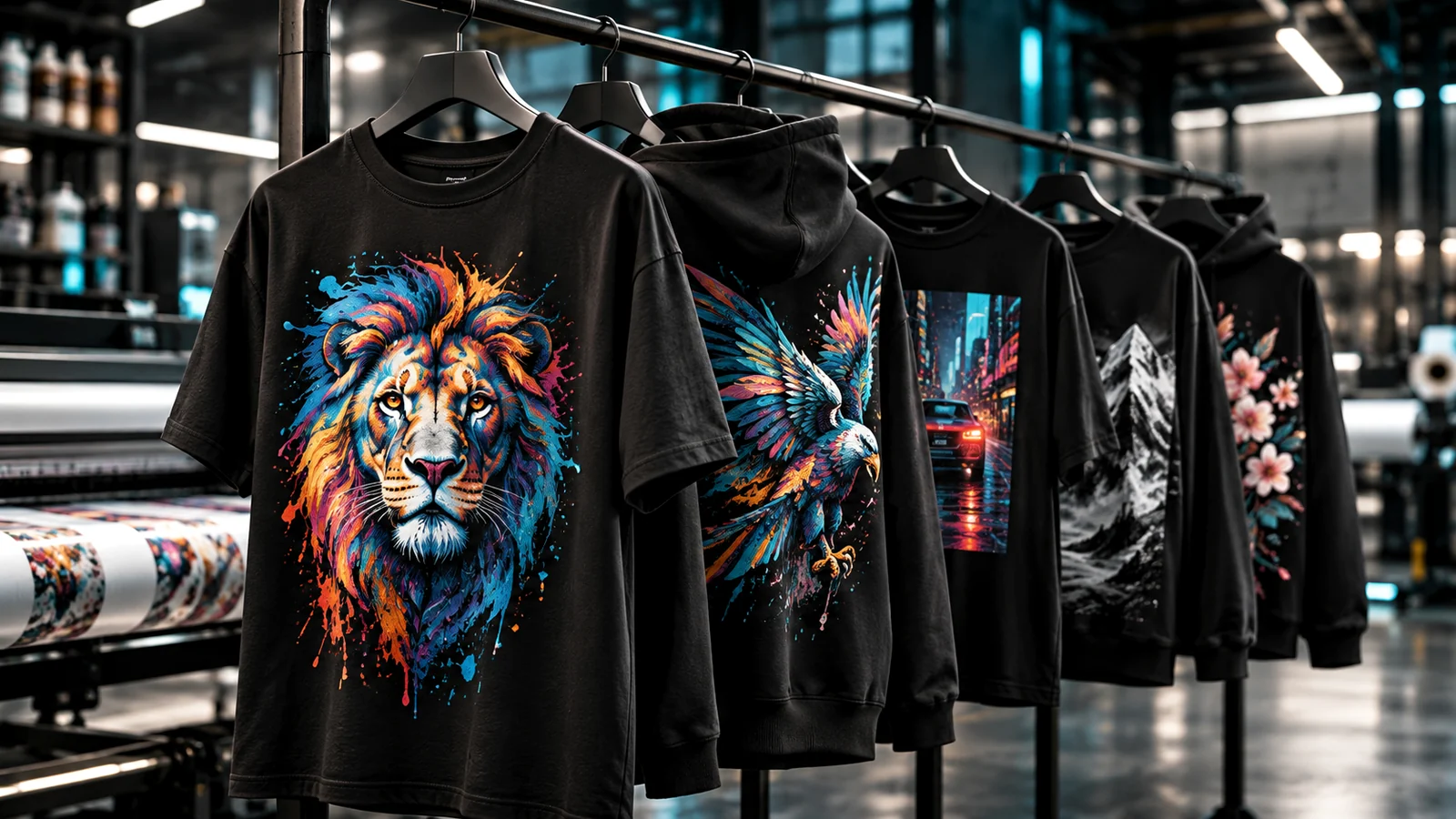
You receive finished DTF transfers on a roll, ready for you to heat press onto garments or other suitable textiles.
The nominal roll width is 600 mm. The maximum actual printable width is 580 mm.
The minimum order is 1 running metre.
Up to 499.9 m the rate is PLN 18 net/m. From 500 m, the entire order is charged at PLN 16 net/m. For very large or recurring volumes, you can also ask us about individual commercial terms.
We recommend 1:1 scale, around 300 DPI for raster artwork, a transparent background and a maximum width of 580 mm. Direct upload supports PNG, PDF and ZIP. Send TIF/TIFF and larger files via WeTransfer, Google Drive or Dropbox.
Yes. Wherever the garment should remain visible after application, the background should be transparent. A white rectangle in the file will be treated as part of the design and printed.
We accept correctly prepared RGB and CMYK files. Final production setup is completed in our RIP.
Yes. Files receive a technical pre-production check and RIP setup. We only carry out safe production-related adjustments that do not alter the approved design. We do not automatically correct wording, spelling or graphics. If a change would affect the appearance, we contact you before production.
Send it via WeTransfer, Google Drive or Dropbox and include a working download link with your enquiry or order.
Production can be completed in as little as 24 hours. The exact lead time depends on current workload, order size and whether the supplied artwork is production-ready.
Finished transfers are currently dispatched within Poland. Available delivery methods and the current delivery cost are shown during checkout.
Online payments are processed by Tpay. Available methods include BLIK, fast bank transfer and card payment.
As a starting point, use 150–160°C for 10–15 seconds with medium-to-firm pressure, followed by a short final press after removing the film.
Yes. For recurring and larger orders, we can agree individual terms and a practical production workflow.